A multidisciplinary UX/UI designer
MedWrite
University project in partnership with MedWrite
Duration
3 months
Full UX and UI Design process
Team
Interviews: whole class to share data
The rest: Just me :)
Client
MedWrite, Ireland
Goal
To improve how caregivers understand, retain, and act on discharge information after their child’s emergency department visit.
Overview
It is essential that caregivers leave the emergency department (ED) with the knowledge and confidence to manage their child’s care at home. However, many struggle to recall key information after discharge, including the diagnosis, medications given, follow-up steps, and signs that require further medical attention.
In Ireland, a significant number of parents visit the ED seeking reassurance or guidance, often revealing gaps in their understanding of their child’s health needs. This highlights a critical opportunity to improve post-discharge communication and support for caregivers.

Methodology
The methodology for this project was based on the Jobs-to-be-Done (JTBD) framework, focusing on understanding the real needs and motivations behind caregivers' actions following an emergency department visit.
The research began with interviews conducted with parents who had recently visited the ED with their child. This phase was part of a collaborative effort across our class , we interviewed 14 parents in total and shared our findings with one another.
From there, we individually carried out thematic analysis of the interview data, identifying recurring patterns, behaviors, and emotional responses. These themes were used to generate actionable insights that informed the rest of the design process.

Problem statement, Persona. Journey map and ideation
Once the insights were generated, I was able to move forward with clearly defining the core problem based on real user needs and behaviours. This allowed me to create a focused problem statement that guided the rest of the design process. I also developed a detailed user persona to represent the key caregiver group, capturing their goals, frustrations, and decision-making patterns. To further understand the end-to-end experience, I created a user journey map, which helped visualise pain points, emotional moments, and opportunities for meaningful design intervention across the post-discharge process.

Wireframe and interactive prototype
With the foundations in place, I began by creating quick, hand-drawn sketches to better understand the user flow. This helped me map out the user flow architecture, identify the most important screens aligned with the Jobs-to-be-Done, and organise features into three tiers: essential, important, and nice-to-have. From there, I created a working interactive prototype, which I first brought to a CRIT session with my classmates to gather early design feedback before moving on to user testing with real users.

User Testing
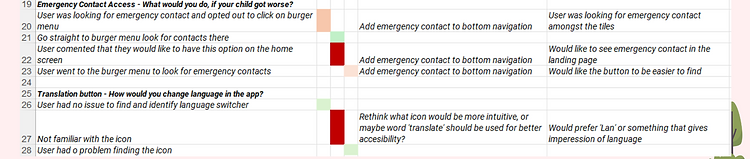
For the user testing phase, I began by defining a clear evaluative research plan using the HEART framework to align testing with user-centered success metrics. I then conducted one-on-one sessions using a combination of Rainbow Testing and the $100 Feature Test, where participants were asked to walk me through their actions and explain which features they valued most, and why.
Some of the responses were surprising and offered unexpected insights into user priorities and mental models. As a result, I was able to identify a list of additional features to further refine and improve the design.
As part of my process, I also included an autoethnography summary to reflect on personal learning, decision-making, and how my own assumptions evolved throughout the project.